


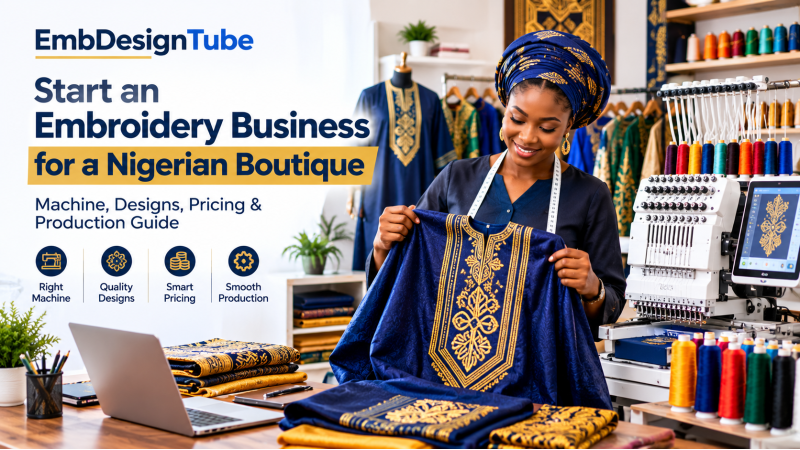
How to Start an Embroidery Business for a Nigerian Boutique
Starting an embroidery business in Nigeria can be much more than buying an embroidery machine and stitching logos. For a boutique owner, embroidery can become a profitable production service that adds value to Agbada, Kaftan, Senator wear, traditional clothing, Aso-Ebi outfits, bridal garments, uniforms and other fashion products.
The biggest opportunity is to build a complete embroidery workflow around the machine you already own or plan to operate: choosing the right designs, understanding machine and hoop requirements, pricing each job correctly, testing files before production, delivering consistent quality and keeping a reliable library of machine-ready embroidery designs.
This guide explains how Nigerian boutique owners can build that workflow step by step, including how to source online embroidery designs, when to use custom digitizing, how to price embroidery work and how to turn embroidery into a dependable part of a fashion business.
Is an Embroidery Business a Good Opportunity for a Nigerian Boutique?
Embroidery can complement a boutique business because it adds an additional production capability without requiring you to completely change the type of clothing you sell.
A boutique may already be producing or selling garments. Adding machine embroidery allows the same business to offer additional value through customized decoration, branded garments and premium traditional fashion.
Instead of competing only on fabric, tailoring or garment construction, you can also compete on:
- Original embroidery styles
- Custom customer designs
- Premium garment finishing
- Personalized names and initials
- Traditional embroidery for native wear
- Corporate branding
- Wedding and occasion embroidery
- Small-batch and made-to-order embroidery
This is especially useful for boutiques that already serve customers looking for differentiated garments rather than basic ready-to-wear products.
Two Ways a Nigerian Boutique Can Build an Embroidery Business
There are two common business models.
Model 1: Embroidery for Your Own Boutique
Under this model, the machine is primarily used on your own garments.
You may produce:
- Agbada
- Kaftans
- Senator wear
- Women's dresses
- Bridal clothing
- Aso-Ebi garments
- Caps and accessories
- Children's clothing
The embroidery increases the perceived value and differentiation of your finished products.
Model 2: Embroidery as a Service
You can also accept embroidery orders from other fashion designers, tailors, boutiques, uniform suppliers, event businesses and individual customers.
In this model, your embroidery machine becomes a separate revenue-generating production service.
Many businesses can combine both models: use the machine for their own garments during quieter periods and accept outside jobs when production capacity is available.
Step 1: Decide What Type of Embroidery Work You Want to Accept
Before building a design library or advertising your service, decide which jobs fit your machine and your target customers.
A practical starting list could include:
- Agbada embroidery
- Kaftan chest and neckline embroidery
- Senator wear embroidery
- Monograms
- Names and initials
- Fashion logos
- Corporate uniforms
- School uniforms
- Caps
- Bridal embroidery
- Wedding and event garments
- Small decorative embroidery
Do not try to offer every possible embroidery service on the first day.
Choose a few applications that match your machine, your customer base and the type of garments you already understand.
For many Nigerian fashion businesses, a strong starting combination can be:
Agbada + Kaftan + Senator + custom logos + personalized embroidery.
Step 2: Understand Your Embroidery Machine Before Taking Orders
Your machine is the center of the business, so you should know its practical production limits.
Record the following information:
- Machine brand
- Exact model
- Single-head or multi-head configuration
- Maximum embroidery area
- Available hoop sizes
- Needle count
- Supported file formats
- Maximum design dimensions
- Recommended speed for different materials
- Thread and stabilizer requirements
Knowing these specifications allows you to decide which jobs you can confidently accept.
For example, a customer may ask for a very large Agbada panel, but the correct question is not simply whether the artwork looks suitable. You need to know whether your hoop and embroidery field can accommodate the required dimensions or whether the design needs to be split into sections.
Step 3: Build Your Embroidery Design Library
A machine without a useful design library can become an expensive piece of equipment sitting idle.
Instead of collecting random embroidery files, build a structured library based on the work you actually receive.
A useful folder structure can be:
- Agbada
- Kaftan
- Senator
- Women's Wear
- Aso-Ebi
- Bridal
- Corporate
- Caps
- Monograms
- Logos
- Borders
- Applique
- Seasonal Designs
Inside each category, save machine and size information whenever possible.
This makes it easier for your team to identify a suitable file when a customer places an urgent order.
Where Should a Nigerian Boutique Get Machine Embroidery Designs?
You can obtain embroidery files from several sources, including in-house digitizing, independent digitizers, online marketplaces and specialized embroidery design websites.
For regular production, an online embroidery library can be particularly useful because you can search for a design according to garment, style, machine format or size instead of waiting for every design to be created from scratch.
When selecting an online embroidery design provider, do not evaluate the site only by the number of designs listed.
Check whether each design provides useful production information such as:
- Machine file formats
- Design dimensions
- Stitch count
- Number of colors
- Hoop requirements
- Clear preview
- Instant digital delivery
- Customization support
- Customer support
For Nigerian boutique owners, a provider that understands traditional garments and commercial embroidery requirements can be much more useful than a generic collection containing thousands of unrelated decorative patterns.
Explore machine embroidery designs from EmbDesignTube.
Step 4: Learn the Main Embroidery File Formats
One of the first technical skills an embroidery business owner should understand is file-format compatibility.
Common machine embroidery formats include:
- DST
- PES
- JEF
- EXP
- VP3
- HUS
- XXX
- EMB
The correct format depends on the machine and software being used.
Never assume that a design will work simply because another machine from the same manufacturer can read it.
Check the exact model documentation or test the file before production.
For commercial embroidery businesses, DST is widely encountered in professional workflows, while formats such as PES and JEF are commonly associated with particular machine ecosystems. The exact requirements should always be checked against the machine model.
Step 5: Choose Designs According to the Garment
A common mistake is to choose an attractive embroidery design first and only later decide where it will be placed.
Professional production works in the opposite direction.
Start with the garment.
Agbada
Agbada designs may require large front panels, neckline elements, sleeve details or coordinated motifs.
Because large native-wear embroidery can require substantial stitch coverage, check the design size, hoop requirement, stitch count and fabric before accepting the order.
Kaftan
Kaftan embroidery can be concentrated around the chest, neckline, sleeves, pockets or front opening.
Having several size variations of a design can make production much easier.
Senator Wear
Senator garments often provide opportunities for more controlled embroidery placement.
Simple but well-digitized patterns can work effectively when the customer wants a premium result without excessive coverage.
Women's Wear
Women's garments may require floral designs, borders, neckline patterns, lace-inspired motifs and carefully positioned decorative elements.
For fitted garments, consider seams, darts, curves and garment construction when deciding where the embroidery should be placed.
Step 6: Decide When to Use Ready-Made Designs and When to Use Custom Digitizing
A successful embroidery business should know when to use each option.
Use Ready-Made Designs When:
- The design already matches the customer's requirements
- You need production quickly
- You want to offer multiple styles
- You regularly produce similar garments
- You want to keep design-development cost under control
Use Custom Digitizing When:
- The customer provides unique artwork
- A fashion brand needs its own signature embroidery
- You need a specific Agbada panel
- The artwork must fit an exact measurement
- You need specific thread colors
- A logo must be reproduced for embroidery
- An existing design does not stitch appropriately at the required size
Custom digitizing is not simply converting an image into a machine file.
A good digitizer must consider the final embroidery size, fabric, stitch construction, underlay, density, sequencing and the machine's production requirements.
Request custom embroidery digitizing from EmbDesignTube.
Step 7: Price Your Embroidery Work Correctly
Pricing is one of the biggest decisions in an embroidery business.
Do not price every job by design size alone.
Your quotation should consider the complete production requirement.
Important cost factors include:
- Design or digitizing cost
- Number of stitches
- Number of garments
- Machine running time
- Thread consumption
- Stabilizer
- Backing
- Needles and consumables
- Garment handling
- Operator time
- Design testing
- Rework or revisions
- Urgent delivery requirements
For custom embroidery, separate the design-development charge from the production charge whenever appropriate.
This prevents a situation where a customer pays for embroidery but expects unlimited digitizing, resizing and artwork revisions at no additional cost.
How to Create a Simple Embroidery Pricing Formula
A practical pricing structure can be built around three parts:
Design preparation + embroidery production + additional services.
For example, your quotation can separate:
Digitizing: artwork preparation and machine file creation.
Production: actual stitching cost based on quantity and production requirements.
Extras: rush delivery, garment handling, special thread requirements, resizing or additional versions.
This makes your quotation easier for customers to understand and protects your margin.
Step 8: Always Test an Unfamiliar Design Before Final Production
A preview image is not a substitute for a test stitch.
Before stitching an expensive garment, test the design on a comparable fabric with an appropriate stabilizer whenever the design is unfamiliar or technically demanding.
Watch for:
- Thread breaks
- Fabric puckering
- Uneven density
- Registration problems
- Weak small details
- Excessive thread changes
- Unnecessary trims
- Design distortion
If the result is not satisfactory, resolve the design problem before putting the same file onto multiple customer garments.
Step 9: Build a Professional Embroidery Workflow
A repeatable workflow helps a small boutique operate like a professional production business.
Use a workflow such as:
Customer request → garment measurement → design selection → machine compatibility check → quotation → artwork approval → file preparation → test stitch → production → quality check → delivery.
For custom projects, add an approval stage before final digitizing or production.
Keep records of the final approved design, dimensions, format, thread colors and production notes. This becomes extremely valuable when the same customer orders another garment later.
Step 10: Create a Customer Approval Process
Do not begin every custom embroidery order based on a verbal instruction such as “make something elegant.”
Ask the customer for specific information.
A good intake form should include:
- Garment type
- Artwork
- Embroidery placement
- Final width
- Final height
- Machine type
- Hoop size
- Preferred file format
- Thread colors
- Quantity
- Required completion date
- Special instructions
This is especially useful for Agbada and other large-format traditional garments where dimensions and placement can significantly affect the finished result.
Step 11: Build a Portfolio Around Nigerian Fashion
Your embroidery machine becomes easier to sell when customers can see what you can actually produce.
Create sample garments covering different styles.
Your portfolio could include:
- Traditional men's Agbada
- Kaftan
- Senator wear
- Women's traditional wear
- Aso-Ebi
- Bridal garments
- Corporate uniforms
- Monograms
- Logo embroidery
- Caps
Photograph the finished embroidery rather than relying only on digital design previews.
Show close-up details so prospective customers can evaluate stitch quality, density, registration and finish.
Step 12: Use WhatsApp and Social Media as Part of the Sales Process
Digital discovery matters for fashion businesses, and Nigeria has a large internet and social-media user base. DataReportal reported 109 million internet users and 47.8 million social-media user identities in Nigeria at the end of 2025.
For an embroidery business, social media should not be treated only as a gallery.
Use your content to answer buying questions.
Examples include:
- Which Agbada embroidery design fits a particular hoop?
- What does a large chest panel look like after stitching?
- Which embroidery file format does your machine require?
- What happens when a customer provides a logo?
- How does custom digitizing work?
- How long does production take?
Short videos showing the design being stitched can be particularly useful because they demonstrate that you are selling a production capability, not merely digital artwork.
Step 13: Make Your Boutique Easy to Find Locally
Once your embroidery service is ready, optimize your local presence.
Your business profile and website should clearly communicate:
- Embroidery service
- Machine embroidery
- Custom embroidery
- Agbada embroidery
- Logo embroidery
- Traditional wear embroidery
- Location and service area
- Contact method
Use real production photographs wherever possible.
A customer searching for “Agbada embroidery near me” or “machine embroidery service in Lagos” is much closer to a purchase than someone searching for general embroidery inspiration.
Step 14: Consider Business Registration and Professional Operations
As your embroidery activity becomes a formal commercial service, review the registration and compliance requirements appropriate to your business structure.
Nigeria's Corporate Affairs Commission provides an official Business Name registration process through its Company Registration Portal, and its guidance states that individual proprietors can register business names without requiring a legal practitioner, chartered accountant or chartered secretary. Always verify current requirements, fees and applicable obligations directly with the CAC before making business decisions.
Check the Corporate Affairs Commission business-name registration information.
Step 15: Keep Your Design Library Legally and Operationally Organized
Do not treat downloaded embroidery files as ordinary pictures.
Maintain records of where designs came from and what usage rights apply.
For commercial production, check the supplier's terms before using designs on garments that you sell.
Also separate:
- Ready-made purchased designs
- Custom client-owned artwork
- Your original artwork
- Licensed designs
- Production-approved files
- Old or untested files
This becomes increasingly important as your design library grows.
How to Avoid the Most Common Embroidery Business Mistakes
Mistake 1: Buying the Machine Before Understanding the Business Model
A machine should match the work you intend to produce.
Think about garment size, hoop requirements, production volume and target customer before making equipment decisions.
Mistake 2: Buying Hundreds of Designs Without a System
A large library is not valuable if nobody can quickly find the right file.
Organize designs by garment, size, machine, format and production use.
Mistake 3: Choosing Designs Only by Appearance
The best-looking preview is not necessarily the best-performing embroidery file.
Review technical specifications and test the design where appropriate.
Mistake 4: Underpricing Custom Work
Digitizing, testing, production and revisions all require time.
Make sure your pricing covers the complete workflow.
Mistake 5: Promising Unlimited Revisions
Define how many design revisions are included in a custom project and what qualifies as a new design request.
Mistake 6: Accepting Jobs Beyond Your Equipment
Do not accept an embroidery job simply because the customer is ready to pay.
First confirm that the design and garment are compatible with your machine, hoop and production setup.
Mistake 7: Not Keeping Production Records
Record successful settings, file versions, thread colors, stabilizer choices and garment-specific notes.
Your future production becomes faster when you do not need to solve the same problem twice.
How to Increase the Value of Each Embroidery Order
Once your basic service is stable, increase average order value through complementary services.
For example, one customer may need:
- Custom digitizing
- Agbada embroidery
- Multiple sizes
- Matching sleeve embroidery
- Logo embroidery
- Additional garments
Instead of selling a single embroidery job, create a complete production solution.
Build Repeat Customers Through Design Consistency
Fashion businesses often return to suppliers that provide predictable results.
Suppose a customer has approved a particular embroidery style for a clothing line. Keep the approved design, final dimensions, colors and production notes organized.
When that customer returns, you can reproduce the same result or create a matching design more efficiently.
Consistency can become a competitive advantage.
When Should You Invest in More Equipment?
Do not upgrade equipment simply because a larger or faster machine is available.
Upgrade when production demand demonstrates a clear need.
Signs that capacity may be becoming a limitation include:
- Too many orders waiting for production
- Large jobs exceeding your current hoop capacity
- Excessive machine downtime between orders
- Frequent outsourcing of embroidery
- Increasing demand for multiple garments at once
- Customers regularly requesting services you cannot currently provide
Before purchasing another machine, analyze your actual order volume, average production time and profitable product categories.
How Online Design Solutions Can Reduce Design Development Time
One of the biggest advantages of online embroidery design resources is the ability to access ready-made machine embroidery files instead of developing every design internally.
This can be particularly useful when a customer needs a design quickly.
A practical workflow is:
Customer requests a style → search a relevant design collection → check dimensions → verify machine format → review production specifications → download → test → produce.
When no suitable design exists, move directly to custom digitizing instead of forcing an unsuitable ready-made file into production.
Try free embroidery designs from EmbDesignTube before building a larger design library.
A Practical Embroidery Business Setup Checklist
Before accepting regular customer orders, make sure you can answer “yes” to the following questions:
- Do I know my machine's maximum embroidery area?
- Do I know which file formats it uses?
- Do I have the required hoop sizes?
- Can I test a design before production?
- Do I have reliable thread and stabilizer supplies?
- Do I have a structured design library?
- Can I calculate the cost of each job?
- Do I have a quotation process?
- Can I take custom artwork from customers?
- Do I have access to professional digitizing when necessary?
- Do I have sample garments for my portfolio?
- Can customers easily contact me through WhatsApp or another convenient channel?
- Do I have a system for saving customer-approved designs?
A Simple Workflow for a Nigerian Boutique With an Embroidery Machine
Here is a practical example.
Customer: A customer wants a premium embroidered Agbada.
Step 1: Record the garment type and requested embroidery placement.
Step 2: Measure the available embroidery area.
Step 3: Confirm the machine and hoop.
Step 4: Search a professional embroidery design library for suitable Agbada designs.
Step 5: Review dimensions, stitch count, format and colors.
Step 6: Send the design preview to the customer for approval when needed.
Step 7: Download the appropriate machine format.
Step 8: Test stitch the design.
Step 9: Make any required production adjustments.
Step 10: Stitch the final garment.
Step 11: Photograph the finished garment for your portfolio.
Step 12: Save the approved file and production notes for future orders.
This process transforms embroidery from an improvised service into a repeatable business operation.
How EmbDesignTube Fits Into the Workflow
EmbDesignTube can be used in two complementary ways by Nigerian boutique owners.
First, you can use ready-made machine embroidery designs when a suitable design is already available.
Second, you can use professional custom digitizing when your customer requires artwork, dimensions, colors or placement that cannot be satisfied by an existing design.
This combination allows a boutique to maintain a design library for fast production while still accepting exclusive or highly customized embroidery work.
Browse machine embroidery designs or request custom digitizing.
Frequently Asked Questions
How much money do I need to start an embroidery business in Nigeria?
The required investment varies considerably depending on whether you already own an embroidery machine, the machine's capacity, your workspace, thread and consumable requirements, software, digitizing needs and the type of customers you plan to serve.
Instead of using one generic startup figure, calculate your investment according to the actual workflow you intend to operate.
Can I start an embroidery business from an existing boutique?
Yes. A boutique can add machine embroidery as an additional production service. This can allow you to increase the value of existing garments and accept embroidery work from other customers.
What embroidery designs should I buy first?
Start with designs that match your existing customer demand. For a Nigerian fashion boutique, this may include Agbada, Kaftan, Senator, traditional men's wear, women's wear, bridal and personalized designs.
Which embroidery file format should I use?
The correct format depends on your machine model. Confirm your machine's supported embroidery formats before downloading or purchasing designs.
Can I make custom Agbada embroidery designs?
Yes. Custom digitizing is appropriate when you need a specific garment panel, unique artwork, exact dimensions, selected thread colors or an exclusive design.
Should I test an embroidery design before using it on a customer's clothing?
Yes. Testing is particularly important for large designs, dense designs, expensive garments and unfamiliar embroidery files.
Can I sell garments made using purchased embroidery designs?
That depends on the license or usage terms associated with the design. Always review the supplier's terms before using a design commercially.
Can embroidery become a separate service for other Nigerian fashion businesses?
Yes. A boutique with available machine capacity can offer embroidery services to tailors, fashion designers, clothing brands, uniform suppliers, event businesses and individual customers.
Final Thoughts: Build an Embroidery Business Around Production, Not Just the Machine
The embroidery machine is only one part of the business.
A successful Nigerian boutique embroidery operation needs four things working together:
The right machine.
The right embroidery designs.
The right production workflow.
The right customer and pricing strategy.
When these four elements work together, embroidery can become a powerful extension of a boutique rather than an isolated service.
Start with the garments your customers already buy. Build a design library around those garments. Learn your machine's file and hoop requirements. Test designs before production. Price the complete job instead of only the stitching. Use ready-made embroidery files for speed and professional custom digitizing for unique requirements.
For Nigerian boutiques producing Agbada, Kaftan, Senator, Aso-Ebi, bridal and other fashion garments, the goal is not to collect the largest possible number of embroidery files.
The goal is to build a reliable library of machine-ready designs that you can find, test and produce confidently when a customer places an order.
Ready to build your embroidery design library?
Explore EmbDesignTube's machine embroidery designs.
Need an exclusive design for your boutique or customer?