



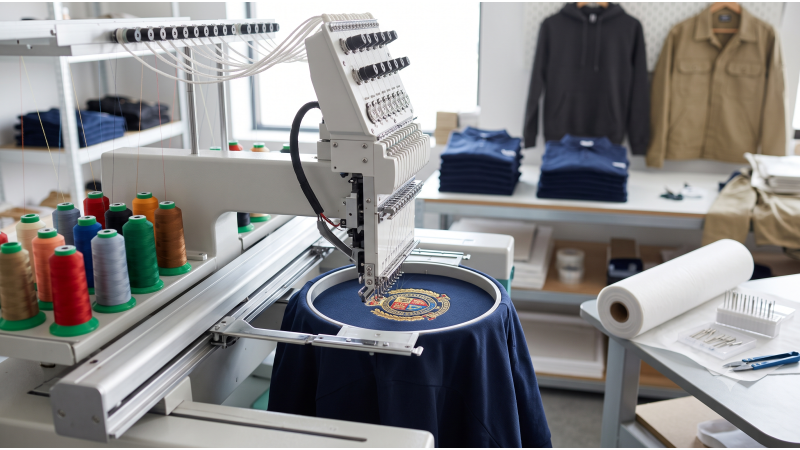
Quick answer: Most left-chest embroidery designs measure 3 to 4 inches wide and run roughly 4,000 to 8,000 stitches, depending on the garment. Polos usually sit at the low end, hoodies and twill jackets higher. Use a cutaway backing on knits, choose the file format your machine reads natively (DST, PES or EXP), and always run a test stitch-out before a bulk order.
The left-chest logo is the workhorse of commercial embroidery. Polos, work shirts, hoodies, and twill jackets for hotels, trades, clinics, and sports clubs all carry one, and a single uniform contract can mean hundreds of identical placements. That repetition is exactly why a weak file is so expensive. A logo that puckers on a pique polo or breaks thread on a twill jacket does not fail once; it fails on every garment in the batch.
EmbDesignTube.com supplies production-ready, stitch-tested files for uniform and workwear programs, in the formats commercial machines actually read. This guide covers stitch counts by garment, sizing and placement, underlay, backing, file formats, and how to handle bulk corporate logo orders without losing margin.
Left-Chest Embroidery Size and Placement Standards
Before you look at stitch counts, fix the size. Size drives everything else, because a logo that is too big for the garment gets dense, stiff, and prone to puckering.
- Typical width: 3 to 4 inches (75-100 mm) for adult shirts and jackets. Many brands standardize on 3.5 inches.
- Typical height: 1.5 to 3 inches (40-75 mm), depending on the logo's proportions.
- Placement: usually centered about 4 to 6 inches below the shoulder seam and 4 to 5 inches from the center front, on the wearer's left. Always confirm against the client's brand guide and keep placement identical across sizes where possible.
- Smaller garments: ladies' fits and youth sizes often need a scaled logo, around 2.5 to 3 inches wide. Scale from the source file, not by stretching a finished stitch file.
Consistent placement matters as much as the file itself. A reliable template or placement guide saves more time on a 300-piece uniform order than any other single step.
Stitch Count Ranges: Polos vs. Hoodies vs. Twill Jackets
Stitch count follows from size, detail, and fabric. The figures below are common starting ranges for a 3 to 4 inch left-chest logo. They are not guarantees, since density settings, thread weight, and artwork complexity all shift the number. Confirm with a test stitch-out on the actual garment.
| Garment | Typical stitch count | Fabric behavior | Digitizing priority |
|---|---|---|---|
| Pique or performance polo | 4,000 to 7,000 | Light, stretchy knit that puckers easily | Lower density, stable underlay, cutaway backing, topping on textured pique |
| Dress or work shirt (woven) | 3,500 to 6,000 | Thin, tight weave that shows every stitch | Light fills, small satin columns, tearaway or light cutaway |
| Fleece or heavy hoodie | 5,000 to 8,000 | Thick pile that swallows stitches | Stronger underlay, topping, cutaway backing, slightly open fills |
| Twill jacket or work coat | 6,000 to 9,000 | Dense, stable weave | Firm underlay, standard density, 80/12 or 90/14 needle |
| Fitted caps (for reference) | 5,000 to 8,000 | Stiff buckram | Digitize separately for caps; do not reuse chest files |
If a logo lands well above the range for its garment, simplify the artwork before you add density. Removing a hairline outline or merging tiny details usually produces a cleaner, faster, more profitable run than forcing a complex design into a small space.
Underlay: Edge-Run, Center-Run, and Zigzag
Underlay is the stitching beneath the visible stitches. It stabilizes fabric, lifts the top stitches off the surface, and prevents shapes from sinking into the weave. Uniform logos rely on three common types.
- Edge-run (edge walk): a single line of stitches just inside the shape's border. It defines the edge and anchors the fabric. It is the baseline underlay for almost every satin column and fill.
- Center-run: a line down the middle of a narrow satin column. It supports thin lettering and stroke shapes without adding bulk, which makes it a good fit for small text on polos.
- Zigzag or lattice: a loose crisscross under larger fills. It holds the fabric flat and gives wide areas a stable base, which is important on fleece and knits.
A practical pairing for most left-chest work is center-run under small satin text, edge-run plus zigzag under fills, and a firmer combination on fleece and twill. The key idea is that thick or stretchy fabric needs stronger underlay and lighter top stitching, not the reverse.
Need uniform-ready logo files? Browse the EmbDesignTube design collection for crests, monograms, and lettering sets, or send your client's artwork through our custom digitizing service for a production-tested file.
Cutaway vs. Tearaway Backing by Fabric
Backing choice is the quiet cause of many puckering complaints. The wrong stabilizer can make a perfectly digitized logo look cheap after the first wash.
| Fabric | Recommended backing | Why |
|---|---|---|
| Pique and jersey polos | Cutaway (about 2.5 oz) | Knits stretch; cutaway keeps the design stable through wear and washing |
| Performance and moisture-wicking fabrics | No-show mesh cutaway | Soft, thin, and invisible through light colors |
| Fleece and hoodies | Cutaway, plus water-soluble topping | Supports the pile; topping keeps stitches from sinking |
| Twill, canvas, denim | Tearaway or light cutaway | Stable weaves hold the design well; tearaway is faster and cleaner |
| Thin woven dress shirts | Light tearaway or soft cutaway | Avoids show-through and stiffness |
The simple rule: use cutaway on anything that stretches, and reserve tearaway for stable woven fabrics. When in doubt on a uniform contract, cutaway is the safer choice, because the garment will be washed hundreds of times.
File Formats for Uniform Programs: DST, PES, and EXP
Most uniform shops run mixed equipment, so format compatibility matters as much as digitizing quality.
- DST: the commercial standard, read by Tajima, Barudan, Ricoma, and most multi-head controllers. It holds stitch data but no thread color information.
- PES: the native format for Brother and Baby Lock machines. It carries thread color data, so designs open with a color order assigned.
- EXP: the stitch-only format used on Melco machines.
Buy the format your machine reads natively and avoid converting on the shop floor, since trims and stitch order are the first things to break. For a full breakdown, read our commercial embroidery designs DST PES guide. If you also run cap programs, the cap embroidery guide covers why cap files must be digitized separately from chest files.
Small Text and Fine Detail on Left-Chest Logos
Corporate logos often include a company name or tagline in tiny type. This is where most uniform logos fail.
- Minimum letter height: keep capital letters at least about 0.25 inch (6 mm) tall on a standard logo, and about 0.2 inch (5 mm) at the absolute minimum with clean, bold fonts.
- Simple fonts: sans-serif and slab fonts hold up better than thin script or fine serifs.
- Satin width: satin columns work best between roughly 1 and 7 mm. Narrower becomes unreliable, wider can snag and needs a fill instead.
- Textured fabrics: add a water-soluble topping on pique and fleece so the lettering stays crisp.
- Taglines: if a tagline cannot hold at 3.5 inches wide, propose a version without it for the chest and keep the full lockup for larger placements.
Bulk Files and Workwear Programs: Protecting Your Margin
A uniform contract is won or lost on consistency and turnaround. A few habits keep repeat orders profitable.
- Approve once, reuse forever. Get written client sign-off on a stitched sample, then store the final file with the approved settings. The second order should never need a new test.
- Keep a settings sheet per garment type. Record needle, thread, speed, backing, and topping for polos, hoodies, and jackets separately.
- Buy stock motifs, digitize custom logos. Use pre-tested files for common crests, monograms, and lettering, and reserve custom digitizing for the client's own artwork.
- Standardize placement. Use a placement template so every garment in the batch matches.
- Batch by garment, not by order. Running all polos, then all hoodies, avoids repeated backing and hoop changes.
Why Uniform and Workwear Suppliers Choose EmbDesignTube
- Production-ready files: digitized and stitch-tested for commercial machines.
- Machine-friendly formats: DST, PES, EXP, JEF, and EMB options for Tajima, Barudan, Ricoma, Melco, and Brother systems.
- Built for repeat orders: clean, consistent files that reproduce the same result on the hundredth garment.
- Custom logo support: send artwork and receive a test-ready file through our digitizing service.
- Direct help: chat on WhatsApp or use the contact page.
Left-Chest Troubleshooting Checklist
| Problem | Likely cause | Fix |
|---|---|---|
| Puckering around the logo | Too much density, weak backing, or over-tight hooping | Open up fill spacing, switch to cutaway, and hoop without stretching |
| Stitches sinking into fleece or pique | No topping, weak underlay | Add water-soluble topping and a stronger underlay |
| Small text fills in or looks fuzzy | Letters too small or too dense | Enlarge text height, use center-run underlay, or simplify the font |
| Outline misaligned with fill | No push compensation or fabric shift | Add compensation and check hooping tension |
| Logo looks different on each garment size | Scaling the stitch file rather than the source art | Resize from the source file so density recalculates |
Frequently Asked Questions
What size should a left-chest embroidery logo be?
Most left-chest logos are 3 to 4 inches wide, with 3.5 inches the most common standard. Ladies' and youth sizes often use 2.5 to 3 inches. Place the logo roughly 4 to 6 inches below the shoulder seam on the wearer's left, and follow the client's brand guide.
How many stitches should a left-chest logo have?
A typical left-chest logo runs about 4,000 to 8,000 stitches. Polos tend toward 4,000 to 7,000, hoodies 5,000 to 8,000, and twill jackets 6,000 to 9,000. Complex artwork or heavy fabric shifts the number, so confirm with a test stitch-out.
Should I use cutaway or tearaway backing for polos?
Use cutaway backing for polos. Pique and jersey knits stretch, and cutaway keeps the design stable through wear and washing. Tearaway suits stable woven fabrics like twill and canvas, but it can let stitches loosen on knits and cause puckering over time.
Which file format is best for corporate logo embroidery?
Use the format your machine reads natively. DST works on most commercial machines including Tajima, Barudan, and Ricoma. PES suits Brother and Baby Lock, and EXP suits Melco. Avoid converting between formats, since trims and stitch order can break.
Ready to lock in a repeatable uniform program? Browse all EmbDesignTube designs, or contact our team to find the right file for your machine and garment.