Quick answer: Embroidery for home decor and upholstery needs files digitized for the fabric, not retail designs scaled up. Use a sharp 90/14 needle (100/16 for very thick material), heavy-duty polyester or rayon thread, density matched to the fabric, a suitable underlay, and a frame system that supports oversized textiles. Source editable EMB files when you need to resize, and DST for production on commercial machines. Always stitch a sample panel on the real fabric first.
Interior design agencies, soft-furnishing studios and architecture decor teams often source embroidery for contract work: curtain borders for a hotel suite, cushions for a restaurant banquette, outdoor canvas for a resort terrace. The artwork may be beautiful, but the file decides whether it stitches cleanly on 200 meters of drapery. Generic retail embroidery designs, built for t-shirts and tote bags, are the usual culprit when puckering, skipped stitches and needle breaks show up on heavy furnishing fabric.
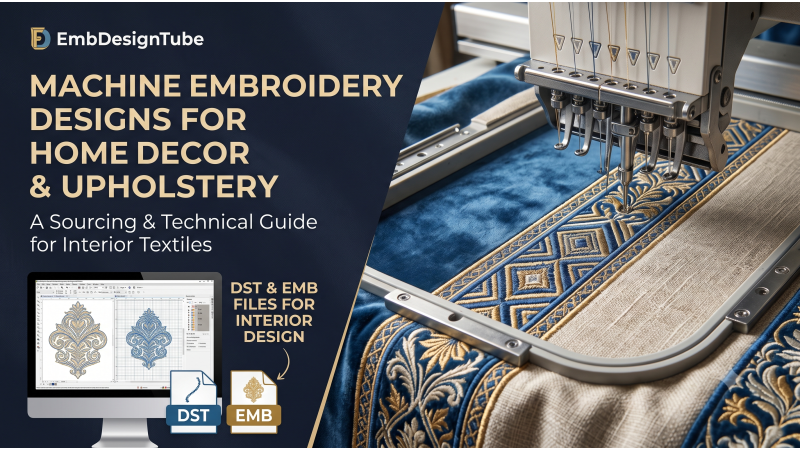
EmbDesignTube.com supplies production-ready, scalable embroidery files in DST and editable formats, and takes custom briefs for commercial interiors. This guide covers why retail designs fail on furnishings, the technical settings that work, how to frame and stitch oversized textiles, current architectural motif trends, and how to brief a supplier so contract orders arrive on spec.
Why Generic Embroidery Designs Fail on Upholstery and Drapes
Furnishing fabrics behave very differently from apparel. Four failure modes show up repeatedly.
- Puckering. A design digitized for a soft knit packs too many stitches into a stiff or lightweight furnishing fabric, pulling the cloth into ripples that never press out.
- Needle deflection and breaks. Heavy upholstery, canvas and multi-layer pieces resist a standard needle. The needle bends off line, skips stitches or snaps.
- Wrong underlay. Pile fabrics such as velvet swallow stitches, and loose-weave linen shifts. Apparel underlay settings do not stabilize either.
- Scale problems. A motif that looks refined on a 4-inch logo stretches thin when blown up to a 30-inch panel, because a finished stitch file does not recalculate density when resized.
A furnishing-grade file solves these at the digitizing stage with fabric-specific density, underlay and compensation, plus artwork that is built to scale.
Technical Breakdown: Needles, Thread and Density
These values are common starting points. Fabric weight, finish and machine vary, so confirm every design on a sample panel cut from the actual material.
| Fabric | Needle | Thread | Density and underlay | Backing and topping |
|---|---|---|---|---|
| Velvet and chenille | Sharp 90/14 (lighter velvets may take 80/12) | Polyester or rayon, 40 wt | Open density; firm underlay to lift stitches off the pile | Cutaway or tearaway; water-soluble topping to stop sinking |
| Linen and linen blends | Sharp 80/12 to 90/14 | Polyester or rayon, 40 wt | Moderate density; light edge-run underlay; avoid over-packing | Cutaway or medium tearaway; stabilize the loose weave |
| Heavy upholstery and jacquard | Sharp 90/14 to 100/16 | Heavy-duty polyester | Standard to slightly open; strong edge-run and lattice underlay | Cutaway or adhesive stabilizer |
| Outdoor and marine canvas | Sharp 90/14 to 100/16 | UV-resistant bonded or solution-dyed polyester | Moderate density; firm underlay; avoid heavy coverage that traps moisture | Tearaway or cutaway depending on weave stability |
| Lightweight drapery and sheers | Sharp 65/9 to 75/11 | Polyester or rayon, 40 wt or finer | Very light density; minimal underlay | Wash-away or fine mesh; see our resort wear guide |
| Faux leather and vinyl | Sharp or leather-point 90/14 | Polyester | Lower density; avoid tight stitch lines that perforate and tear | Light backing or none; no hooping marks |
Needle gauge
For most upholstery and canvas, a sharp 90/14 is the working size, stepping up to 100/16 for thick, multi-layer or tightly woven material. A needle that is too small deflects and breaks. One that is too large leaves holes, so match the size to the fabric, not the thread alone. Replace needles often, since heat and abrasion dull them quickly on dense cloth.
Thread selection
Heavy-duty polyester is the commercial standard for furnishings because it resists abrasion, fading and washing. Rayon gives a richer sheen for indoor decorative pieces but is less durable and less UV-resistant. For anything outdoors, choose UV-stable polyester that suits marine or solution-dyed fabrics. If a spec calls for a specific thread weight, tell the digitizer, because heavier thread changes how density should be built.
Stitch density and underlay
Standard fill spacing sits around 0.40 to 0.45 mm, and furnishings often need slightly more open spacing so the fabric stays flexible. Pile fabrics need underlay strong enough to lift stitches above the surface, while loose weaves need underlay that stabilizes the fabric before the top stitches go down. Avoid stacking heavy underlay on thick upholstery, which builds a stiff ridge. Satin columns work best in the 1.5 to 7 mm range, so split wider areas into fills.
Need furnishing-grade files? Explore the EmbDesignTube design collection, or brief our team through the custom digitizing service for a pattern built to your fabric and scale.
Framing and Stitching Oversized Architectural Textiles
Large curtains, bed linens and wall hangings are limited more by handling than by the file. The garment-style approach of hooping a small area does not work when the fabric weighs several kilos and runs for meters.
- Use a large or border frame. Choose a frame sized to the design, with enough clearance for the stitch field. Border and sash frames suit long, repeating trims.
- Support the weight. Extend the table, roll excess fabric into soft bolsters, or hang it clear of the machine so the drag of the cloth never pulls on the hooped area.
- Keep the fabric grain straight. A skewed grain makes a motif look crooked after finishing. Square the fabric and mark center lines before hooping.
- Avoid crushing pile. For velvet and chenille, float the fabric over hooped backing or use magnetic frames to avoid hoop marks.
- Stitch in registered sections. For designs larger than the frame, split the file into sections with alignment marks so each section joins invisibly. Test the join on a sample before the production run.
- Check clearance. Run a trace of the full field before starting, and confirm the machine arm clears the bulk.
For repeating trims along curtain leading edges and hems, the same rules for aligning repeats apply as in our resort wear embroidery designs guide. For large stitch fields on heavy fabric, the compensation and sequencing advice in our denim jacket embroidery designs guide carries over.
File Formats: Why Scalable, Editable Files Matter
Architectural and interior projects often resize the same motif for a cushion, a curtain border and a wall panel. File format decides how safely you can do that.
- DST: the commercial production format for Tajima, Barudan, Ricoma and most multi-head machines. It is a fixed set of stitches, so resizing more than a modest amount causes density problems.
- EMB (editable source): keeps the design as objects with density and underlay settings, so you can resize, recolor and adjust compensation, then export a fresh DST. This is the format to request when a motif has to scale across products.
- PES, EXP, JEF: machine-native formats for Brother, Melco and Janome systems.
For contract work, request both: an editable EMB file for approved scaling, and a production DST for each size you run. Our commercial embroidery designs DST PES guide explains the differences and why converting on the shop floor causes errors.
Trend Analysis: Architectural Motifs for Hospitality and Residential Projects
Three families of motif are widely used in high-end interiors today. They suit embroidery because they translate cleanly into stitches at scale.
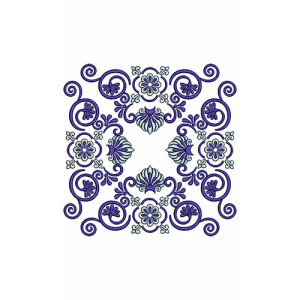
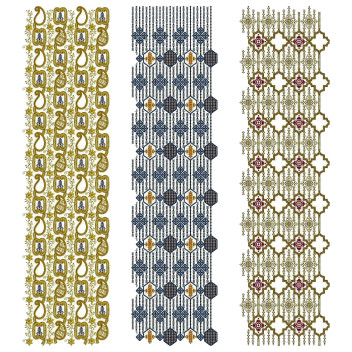
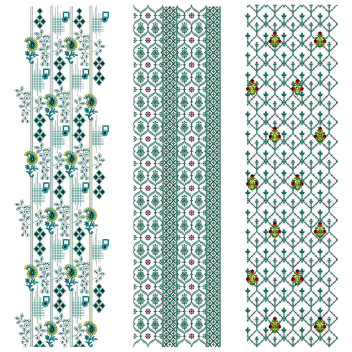
- Geometric borders. Greek key, trellis, chevron, Art Deco and Moorish tile patterns suit curtain leading edges, bed runners and cushion trims. Repeating geometry scales well and reads as architectural. Browse the border bulk designs and border category.
- Botanical damask. Classic damask structures reinterpreted with leaves, branches and blossoms deliver a layered look for drapes and upholstered headboards. See the tree designs and allover bulk designs for scattered and repeating layouts.
- Minimalist line art. Single-line florals, abstract contours and fine architectural sketches suit modern hospitality schemes. They look refined but demand careful sizing, since lines must stay wide enough to read and stitch cleanly on the fabric.
For feature walls and framed pieces, the wall art bulk designs offer larger compositions. For accent pillows, explore the cushion cover embroidery designs and lace trims in the lace bulk designs.
How to Brief an Embroidery Supplier for Contract Work
Most contract problems trace back to an incomplete brief. Send these details with every order.
- Fabric details: fiber, weight, weave or pile, finish, and a swatch if possible.
- Final dimensions and repeat length: including border repeat unit, clearances from edges and hems.
- Thread specification: type, weight and color references. Thread charts rarely match paint or fabric swatches exactly, so approve a physical thread card.
- Performance needs: outdoor exposure, washing, abrasion and fire-safety requirements. Embroidery materials may be assessed separately from the base fabric, so check your project specs.
- Formats required: editable EMB plus production DST, or the native format your machine reads.
- Sample approval: a stitched sample panel on the real fabric, signed off before production.
- Quantity and timeline: total meters or pieces, delivery dates and the number of repeats per piece.
Why Interior Firms Choose EmbDesignTube
- Scalable, precise files: editable source formats plus production DST for commercial machines.
- Fabric-aware digitizing: density, underlay and compensation planned for velvet, linen, upholstery and canvas.
- Architectural motif library: geometric borders, botanical patterns, cushion motifs and wall art.
- Stock or custom: download ready-made designs or send a brief to our digitizing service.
- Direct support: discuss a project on WhatsApp, Telegram, or the contact page.
Home Decor Embroidery Troubleshooting Guide
| Problem | Likely cause | Fix |
|---|---|---|
| Puckering on drapes or linen | Density too high, weak stabilizer, stretched hooping | Open the density, add suitable stabilizer, hoop without stretching |
| Needle breaks or skipped stitches | Needle too small or dull, thick layers | Fit a fresh sharp 90/14 or 100/16, slow the machine |
| Stitches sink into velvet | No topping, weak underlay | Add water-soluble topping and a firmer underlay |
| Hoop marks on pile fabric | Over-tight clamping | Float the fabric or use magnetic frames |
| Motif looks thin after scaling | Resized a finished DST | Resize from the editable EMB source and re-export |
| Sections do not join on large panels | Misaligned registration | Add alignment marks and test the join on a sample |
| Thread fades or degrades outdoors | Non-UV-stable thread | Use UV-resistant polyester and confirm with a sample |
Related Reading
- Commercial Embroidery Designs DST PES: Production File Guide
- Buy Embroidery Designs Commercial Use: Custom vs Pre-Digitized
- Resort Wear Embroidery Designs: Necklines & Lace Borders
- Denim Jacket Embroidery Designs: Back & Western Yoke Guide
Frequently Asked Questions
What needle size should I use for upholstery embroidery?
A sharp 90/14 needle suits most upholstery and canvas, and a 100/16 works for very thick or multi-layer material. Lighter drapery and sheers need finer needles, around 65/9 to 75/11. Replace needles often, since dense furnishing fabric dulls them quickly and causes skipped stitches and breaks.
Can generic embroidery designs be used on upholstery and drapes?
Usually not without problems. Retail designs are digitized for apparel, so their density, underlay and sizing often cause puckering, needle deflection and thin or distorted motifs on furnishing fabrics. Choose files digitized for the fabric and scale, and always stitch a sample panel first.
Which file format is best for commercial curtain embroidery: DST or EMB?
Use both. DST is the production format for most commercial machines but is a fixed stitch set that does not resize safely. EMB is an editable source that lets you scale, recolor and adjust compensation before exporting a fresh DST for each size you run.
How do you embroider oversized curtains without distortion?
Use a large or border frame, support the fabric weight on extended tables, keep the grain straight, and float pile fabrics instead of crushing them in a hoop. Stitch sections with registration marks, run a trace before starting, and test the join on a sample before production.
Ready to brief your next interiors project? Browse all EmbDesignTube designs, or contact our team to discuss fabric, scale and formats.
Related Products