



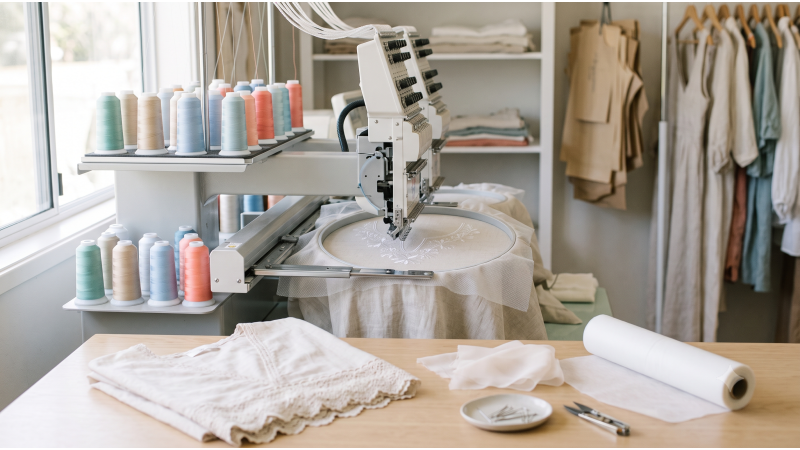
Quick answer: Resort wear embroidery works when the file is lighter than the fabric. Use low-density fills, narrow satin columns, light edge-run underlay, a fine needle (about 65/9 to 75/11), and the right stabilizer: no-show mesh cutaway for knits, light tearaway or wash-away for sheers and lace. Hoop without stretching, slow the machine, and test on the real fabric. DST works on most commercial machines and PES on Brother.
Resort wear is a different game from workwear. The fabrics are linen, cotton voile, chiffon, gauze, jersey and lace, and the buyers are boutiques that charge a premium for finish. A design that runs beautifully on a heavy hoodie will pucker, tunnel and ripple on a cotton voile kaftan, and boutique customers notice. On delicate cloth the file does most of the work, because there is nowhere for a heavy-handed stitch to hide.
EmbDesignTube.com supplies production-ready, stitch-tested files for boutique and resort collections, including necklines, lace borders and floral sets. This guide covers digitizing for delicate and stretch fabrics, stabilizer and needle choices, puckering control, how to build necklines and repeating borders that align, and which styles are selling.
Why Delicate Fabrics Need Lighter Files
Three properties make resort fabrics unforgiving.
- Low body. Voile, chiffon, silk and lawn have little structure. Dense stitching pulls the cloth into ripples around the design.
- Open or loose weave. Linen, gauze and lace let stitches sink or slip, and a heavy needle leaves visible holes.
- Stretch and drape. Jersey and rayon knits distort as they are hooped and as thread tension builds.
The principle is simple. Use the least stitching that fully covers the shape, keep underlay light, and let stabilizer carry the stability that the fabric lacks.
Digitizing Rules for Lightweight and Stretch Fabrics
These are common starting points. Fabric weight, thread and machine vary, so confirm each design with a test stitch-out on the actual garment fabric.
- Fill density: open fills up from the standard 0.40-0.45 mm spacing to roughly 0.45-0.60 mm on sheers and lightweight knits, so the cloth can breathe.
- Satin columns: keep them narrow, roughly 1 to 6 mm. Wide satins pull and snag on delicate cloth, so use a light fill for broad areas.
- Underlay: light edge-run only on thin wovens, and edge-run with a sparse zigzag under larger fills. Avoid heavy lattice that shows through sheer fabric.
- Stitch length: avoid very short stitches stacked together, which perforate the fabric, and very long stitches that snag on wear.
- Pull compensation: modest on stable wovens, a little more on stretch knits, where the fabric draws in as thread tightens.
- Stitch count: favor airy designs with open space. A simple floral often looks richer and runs cleaner than a dense one.
- Outlines and details: hairline outlines and tiny details can disappear or pucker the fabric. Prefer clean, simple shapes.
Stabilizer, Needle and Thread by Fabric
| Fabric | Stabilizer | Needle | Digitizing priority |
|---|---|---|---|
| Cotton voile, lawn, batiste | Light tearaway or soft no-show mesh; wash-away on very sheer pieces | Sharp 65/9 to 70/10 | Open fills, narrow satins, light underlay |
| Silk, chiffon, georgette, organza | Wash-away or fine mesh; avoid anything that tears the weave | Fine sharp 60/8 to 70/10 | Very light density, minimal underlay, slow speed |
| Linen and linen blends | Light to medium tearaway or cutaway | Sharp 75/11 | Moderate density; avoid over-packing, which shows weave distortion |
| Rayon, viscose, challis | No-show mesh or light cutaway | Sharp 70/10 to 75/11 | Drapey and slippery; control pull and shifting |
| Jersey and stretch knits | No-show mesh cutaway | Ballpoint 65/9 to 75/11 | Lower density, extra pull compensation, no tearaway |
| Lace and eyelet | Wash-away stabilizer or fine mesh under the area | Sharp or light ballpoint 65/9 to 75/11 | Open structure; stitch over solid areas, avoid holes |
Thread weight matters too. Standard 40 wt polyester or rayon suits most work, but finer thread can look more elegant on delicate fabric and reduces bulk. Use colorfast thread, since resort wear is washed often and color bleeding on white or pastel cloth is a costly mistake.
When to use a water-soluble topping
Topping sits on the surface and keeps stitches from sinking into texture. It helps on terry, waffle, eyelet, towel and textured knits. On smooth voile or silk it is usually unnecessary and can leave residue, so use it only where the surface demands it and rinse thoroughly.
Looking for boutique-ready files? Explore the EmbDesignTube design collection for florals, necklines and borders, or send artwork through our custom digitizing service for a build tuned to your fabric.
Controlling Puckering on Resort Fabrics
Puckering is the most common complaint on delicate fabrics, and it has several causes working together. Fix them in this order.
- Hoop without stretching. A stretched fabric springs back after unhooping and puckers around the design. Hoop to a snug, neutral tension, or float the garment over hooped stabilizer with temporary adhesive.
- Match stabilizer to fabric. No-show mesh cutaway for stretch, light tearaway or wash-away for stable sheers. Never use a stiff stabilizer that outweighs the fabric.
- Lower the density. Open fills and narrow satins reduce pull, which is often the root cause.
- Use a fresh, fine needle. Dull or oversized needles tear fibers and distort the weave.
- Slow the machine. A slower speed, often around 500 to 650 stitches per minute, reduces fabric shift and thread breaks.
- Check thread tension. Tension that is too tight draws satin columns inward and ripples the cloth.
- Press before and after. Pre-press to remove wrinkles, and steam the finished garment from the wrong side to relax the stitches.
Necklines: Placement, Symmetry and Curves
Neckline embroidery is high-visibility work that frames the wearer's face, so alignment errors show immediately. Digitize and stitch with these points in mind.
- Follow the curve. Scoop, V and boat necklines each need a design shaped to the contour. A straight design forced onto a curve ripples at the ends.
- Keep it symmetrical. Use mirrored left and right halves or a single design that is centered on the front. Mark the center front on the garment and the hoop.
- Respect the neck edge. Leave a consistent margin from the neckline seam or hem, per the style's tech pack, so the motif does not catch in the finishing.
- Stabilize the curve. Necklines are often cut on the bias, so they stretch. Use mesh cutaway or fine stabilizer and avoid pulling the garment while hooping.
- Allow for sizing. Neckline width varies by garment size. Choose a design family sized for each width instead of scaling a finished file, and resize from the source file so density recalculates.
Explore ready-made options in the neckline embroidery designs category, or the neckline bulk designs for wholesale volume.
Lace Borders and Repeating Trims
Borders are decorative bands that run along hems, sleeves, kaftan edges and tiers. Because they repeat, alignment is everything.
- Designed to repeat. A good border file has a clean repeat unit, so the end of one repeat meets the start of the next without a visible seam or gap.
- Hoop in sections. For long hems, stitch one repeat, then re-hoop using registration marks, or use a hoop with alignment guides so repeats line up.
- Check the repeat length. Confirm the repeat length against your hoop size so you stitch whole units, not partial ones.
- Keep scallops sharp. Scalloped edges need clean satin or run stitching along the curve and enough stabilizer to keep the edge flat.
- Open structure for lace looks. Lace-style designs use open space and fine detail. Stitch them on wash-away or fine stabilizer, and keep density low so the pattern stays airy.
- Wash-test before bulk. Wash a sample to check that stabilizer residue, colors and stitch tension hold up.
Browse the lace bulk designs and border bulk designs for repeating trims, or the single-design lace category and border category.
Styles Selling in Resort and Boutique Collections
- Botanical and tropical florals. Hibiscus, palm, frangipani and monstera motifs suit cover-ups, dresses and tops. Keep them airy and open.
- Scalloped and lace-style borders. Hem and sleeve borders add a luxury finish without heavy stitch counts.
- Kaftans and full-dress layouts. Large neckline and front panel designs make a statement. See the kaftan and full dress bulk designs.
- Minimal line art. Fine single-line florals and abstract shapes suit modern boutiques, but they need careful sizing so lines stay visible.
- Monograms and small marks. Initials on cover-ups, towels and bags are a steady seller. Use a bold, simple font so small letters stay legible.
- Allover and scattered motifs. Spaced repeats across larger areas add value. See the allover garment bulk designs.
Resort Wear Troubleshooting Guide
| Problem | Likely cause | Fix |
|---|---|---|
| Puckering around the motif | Over-stretched hooping, heavy density, wrong stabilizer | Hoop without stretching, open the density, switch to suitable stabilizer |
| Holes or visible needle marks | Needle too large or dull | Use a fresh 60/8 to 70/10 sharp or light ballpoint |
| Stitches sink into linen or eyelet | Weak underlay, no topping on textured fabric | Add a light underlay and water-soluble topping |
| Wavy neckline after stitching | Bias stretch during hooping | Use mesh cutaway, avoid pulling, steam after |
| Border repeats do not meet | Hooping misalignment or wrong repeat length | Use registration marks and confirm repeat length |
| Color bleeds on light fabric | Non-colorfast thread | Use colorfast thread and wash-test samples |
| Stabilizer shows through sheer fabric | Heavy or dark stabilizer | Use wash-away or no-show mesh in a matching color |
Why Resort Wear and Boutique Brands Choose EmbDesignTube
- Lightweight digitizing: airy density and clean underlay planned for delicate and stretch fabrics.
- Ready-to-use categories: necklines, lace and border trims, florals and kaftan layouts for boutique lines.
- Commercial formats: DST, PES, EXP, JEF and EMB for Tajima, Barudan, Ricoma, Melco and Brother systems.
- Stock or custom: download ready-made designs or send artwork to our digitizing service.
- Direct support: ask about fabrics and formats on WhatsApp, Telegram, or the contact page.
Formats, Sourcing and Related Guides
Buy the format your machine reads natively: DST for most commercial machines, PES for Brother, EXP for Melco. Avoid converting on the shop floor, because trims and stitch order can break. For a deeper format comparison, read our commercial embroidery designs DST PES guide. If you are deciding between stock files and a custom build for a collection, our guide to buying embroidery designs for commercial use covers cost, turnaround and licensing. For lighter-weight western shirt yokes, the fabric advice in our denim jacket embroidery designs guide applies in reverse: reduce density and needle size as the fabric gets lighter.
Related Reading
- Commercial Embroidery Designs DST PES: Production File Guide
- Buy Embroidery Designs Commercial Use: Custom vs Pre-Digitized
- Denim Jacket Embroidery Designs: Back & Western Yoke Guide
- Left-Chest Embroidery Designs for Uniforms: Stitch Count Guide
Frequently Asked Questions
What stabilizer should I use for embroidery on delicate or sheer fabrics?
Use a light stabilizer that supports the fabric without outweighing it. Wash-away or fine no-show mesh suits chiffon, silk and lace, light tearaway works on stable voile and lawn, and no-show mesh cutaway suits stretch knits. Avoid stiff stabilizers, and test on the actual fabric before a run.
How do I stop puckering on lightweight fabrics?
Hoop without stretching or float the garment over hooped stabilizer, match the stabilizer to the fabric, open up fill density, use a fresh fine needle, slow the machine and check thread tension. Pressing before stitching and steaming afterward also helps the stitches relax.
What needle should I use for resort wear fabrics?
A fine needle works best. Use a sharp 65/9 to 70/10 on voile, silk and chiffon, a sharp 75/11 on linen, and a ballpoint 65/9 to 75/11 on jersey and stretch knits. Replace needles often, since dull points cause holes and snags on delicate cloth.
How do lace border embroidery designs line up when they repeat?
Border files are digitized with a repeat unit that joins end to end. Stitch one repeat, then re-hoop using registration marks or an alignment guide so the next repeat starts exactly where the last ended. Confirm the repeat length against your hoop size and test on a sample first.
Ready to stitch cleaner resort pieces? Browse all EmbDesignTube designs, or contact our team to find the right file for your fabric and machine.